A tool for law review editors to verify footnotes. It extracts citations from Word/PDF files, allows manual correction, validates them via web search, and provides an interactive report with Excel export.
Leona ZhangFuture Trainee SolicitorSearches every published tool by name, practice area, builder and description. Pick a result to jump to it.
A tool for law review editors to verify footnotes. It extracts citations from Word/PDF files, allows manual correction, validates them via web search, and provides an interactive report with Excel export.
Leona ZhangFuture Trainee Solicitor303 tools, newest first
The LawficeDee Swarna · Disputes LawyerThe Lawfice helps consumers work out whether their problem has legal legs and what to do about it. It is an AI-powered tool with a cast of Sims-style agents modelled after The Office, each performing a distinct task: Pam takes your intake and works out what kind of case you have. Dwight pulls the names, dates and keywords that matter. Angela connects to your Gmail and finds the supporting emails herself (using keywords formed from your initial description), or you can upload documents yourself if you prefer. Jim builds a sourced timeline from the evidence. Michael delivers the verdict: pursue it (with a lawyer or independently) or walk away. Oscar drafts any follow-up emails and assembles your full case pack, ready to use or hand to a lawyer.
ChronosDee Swarna · Disputes LawyerAI tool that builds case chronologies instantly. Upload legal documents and automatically extract key events into timelines, exportable as PDF or Word.
Prompting Hand-out for LawyersElgar Weijtmans · Head of TechnologyA modern, user-friendly React application for the prompting guide for lawyers. Built with React, TypeScript, Vite, and Tailwind CSS (with shadcn/ui design system).
origami-methodMichael Paik · Founder, GRC Solutions Korea𝗢𝗿𝗶𝗴𝗮𝗺𝗶 𝗠𝗲𝘁𝗵𝗼𝗱 Lock a one sentence target Build a context packet: objective, boundaries, definition of done Classify risk high enough to justify strict gates Define creases: inputs, outputs, exclusions Run the workflow: read → analyze → draft → gatekeep, test on real cases, log minimal folds, then lock The Origami Workflow Guide helps design the dedicated prompts you need for repeatable workflows, without improvisation.
AI GRC CopilotMichael Paik · Founder, GRC Solutions KoreaThe AI GRC Copilot helps generate a stack of 30 basic artifacts for use in AI GRC. Not everyone needs every item. If you are running high-risk AI in a grown-up organization, this is the map. Governance is, among other things, a documentation engine that produces decisions and proof. If you cannot point to the artifact, the owner, the control and the log, you do not have governance. You have hope. The prompt will not do the job for you. You supply facts, constraints, decisions and approvals. The model drafts and stress-tests. You own the risk. Delegation is not abdication. 𝗙𝗶𝗻𝗮𝗹 𝗟𝗶𝗮𝗯𝗶𝗹𝗶𝘁𝘆 𝗿𝗲𝘀𝘁𝘀 𝘄𝗶𝘁𝗵 𝘁𝗵𝗲 𝗛𝘂𝗺𝗮𝗻.
RedCap-00Michael Paik · Founder, GRC Solutions KoreaRedCap-00 is the first tool in 𝗚𝗥𝗖 𝗻𝗲𝘅𝘁™: a free public self-check, evidence-capped and conservative by design. Use it to evaluate whether your organization can make real operational choices inside 72 hours under disruption. It focuses on five moves: safe pause, treasury reroute, data switchboard, substitution of critical dependencies, and clean market exit.
GRCnext-CopilotMichael Paik · Founder, GRC Solutions KoreaGRCnext™ Copilot scores evidence-backed “Global Optionality” across critical services (Pipes, Switches, Exits) and outputs dossiers, exit tactics, playbooks, drills, and a 90-day backlog.
Contract-Mechanism-Review-AssistantMichael Paik · Founder, GRC Solutions KoreaThis is the spellbook for the Contract Mechanism Review Assistant. It reads slowly, thinks conservatively, and writes with discipline. It treats every agreement as: a mechanism for risk transfer a business plan in clauses a memorialization of future performance It produces clause-by-clause issue spotting, insert-ready edits, fallback positions, and a short deal-risk summary you can paste into an email.
The project is intended to allow lawyers to create playbooks which are applied against uploaded documents, thereby helping with quick review of documents.
A legal document clause extraction and management system powered by AI. Upload legal documents and automatically extract, organize, and search clauses using artificial intelligence.
Contract SimulatorNoam Raz · Deputy General Counsel @ WizUpload a contract, select a stress-test scenario, and get a streaming clause-by-clause AI walkthrough of triggered obligations, timelines, and liabilities.
Vulnerability ScannerNoam Raz · Deputy General Counsel @ WizSelf-hosted web app that scans live websites for security vulnerabilities. 18 scanner modules, real-time SSE streaming, and AI fix prompt export.
AI Governance RegisterNoam Raz · Deputy General Counsel @ WizAI system registry and governance tracker with EU AI Act risk classification, impact assessments, and a compliance dashboard.
Vibe CheckNoam Raz · Deputy General Counsel @ WizClaude Code security audit slash command built for vibe coders. 8 audit phases, 40+ tech stack detection, and 77+ real vulnerability patterns.
Legal FlowNoam Raz · Deputy General Counsel @ WizEnterprise legal operations platform — contract lifecycle, privacy compliance, vendor risk, and team analytics unified in one AI-powered workspace. 6 modules, 30 features, dark/light themes.
Legal Knowledge BaseNoam Raz · Deputy General Counsel @ WizRAG-powered legal knowledge base for institutional memory. Upload documents and ask natural-language questions to get answers with source citations.
License Compliance ScannerNoam Raz · Deputy General Counsel @ WizScan dependency manifests for open-source license compliance. Identifies licenses via package registries and SPDX, evaluates against configurable policies.
MixdItNoam Raz · Deputy General Counsel @ WizPersonal cocktail companion with 1000+ recipes, bar inventory tracking, custom recipe creation, drink history with photos, personal analytics, and smart shopping lists.
GentlrNoam Raz · Deputy General Counsel @ WizAI communication assistant that transforms messages with tone adjustments, clarity improvements, translations, and culture-aware formatting across Slack, Email, WhatsApp, and LinkedIn.
It is an L&D tool to help budding lawyers learn through a gamified experience. You upload case files and it turns the files into a game for learning the essential concepts of that case.
LawvableAntoine Louis · Legal EngineerThe open ecosystem around Agent Skills for law.
I frequently get requests to quickly review a paragraph or two that a client sends in an email. Like most lawyers who live and die with redline I would copy to text and then change format - red, strikethough - and delete text and then change format -green, underlined - to show the changes to the client. I used Google AI Studio to develop an application that allows me to copy the text (or even an image) into a text box, edit in another text box, and show the redline version in another. I can copy the redline as text or an image as well as generate an email that show the redline, explains the changes, and provides the clean text
Fork of Kevin Keller's playbook generator. One of the great parts of being a Legal Quant is that we are cultivating a culture and mindset of seeing someone else's solution and looking for ways to adopt it for your own workflow. I added a web search and gave more options for the LLM (I use an OpenAI compatible proxy for my LLMs).
Gemini Gem developed to assist with developing the PRD and coding instruction for coding assistant that may assist LQ Hackathon participates to generate a starting point for their projects. Gemini Gem at https://gemini.google.com/gem/1dkTy3bsyO2UL6bdhV8NIpptgIIe29hNc?usp=sharing Link to system instructions at https://docs.google.com/document/d/17r6PWMGStv1dGbKwChIPq41e3qc-lWBib7BCloKH05E/edit?usp=sharing
Reviews a contract and extracts out the redline and comments. This is used to generate an issue list that shows the redline, explains the change and provides a recommendation. This was originally developed for my company's own playbook but I have made it generic to allow the user to choose which party they are representing and also provide their own playbook. After the issue list is generated you can download the table and even generate an email to send to one of the people mentioned in the comments. The tagging of the assignee works best is you use an @person or Note to Person in the comment.
Tax Defense StrategistEmmanouil Leivadiotakis · Tax Litigation LawyerLegalStrategy AI: From Raw Ruling to Actionable Defense A sophisticated Proof of Concept (POC) designed to bridge the gap between receiving a court decision and crafting a rebuttal. This "Second Brain" for litigators automates deep fact analysis, timeline generation, and legal issue mapping. Features include a specialized Prescription Detector and a Defense Strategy Mapper that suggests procedural claims based on an integrated jurisprudence database. Export your entire strategy directly to Word to accelerate your filing process.
💡 The problem We’ve all been here: - seeing “in accordance with applicable law” everywhere… but which law exactly? - receiving a contract flooded with redlines with zero explanation - spending days going back and forth, trying to reverse-engineer the counterparty’s rationale then, drafting cross-border contracts while constantly switching between Word and browser tabs worrying we’ve missed something critical I built ClauseWise to tackle exactly these. ⚖️ It helps you: - identify which laws actually apply to your deal - surface relevant regulatory frameworks, including extra-territorial regimes - understand the legal basis and market practice behind clauses - clearly distinguish governing law vs independent regulatory obligations In short, it lays the legal and regulatory foundation for you, so you can negotiate with clarity and confidence. 👩⚖️ Who is this for? - corporate counsel reviewing redlines or drafting agreements - lawyers adapting templates across jurisdictions - anyone who wants to sanity-check if their clauses align with applicable laws As a former dispute lawyer, I would have loved this (especially to cross-check whether my pleadings comply with both substantive and procedural law) to avoid technical mistakes that could get a case struck out from the outset - who knows, we might roll out a separate feature catered to dispute lawyers in my v2 😉 Feel free to try it out here: clause-wise.replit.app
Dark mode, but customisable and pretty
Want one of these adapted for your team? Work with us →

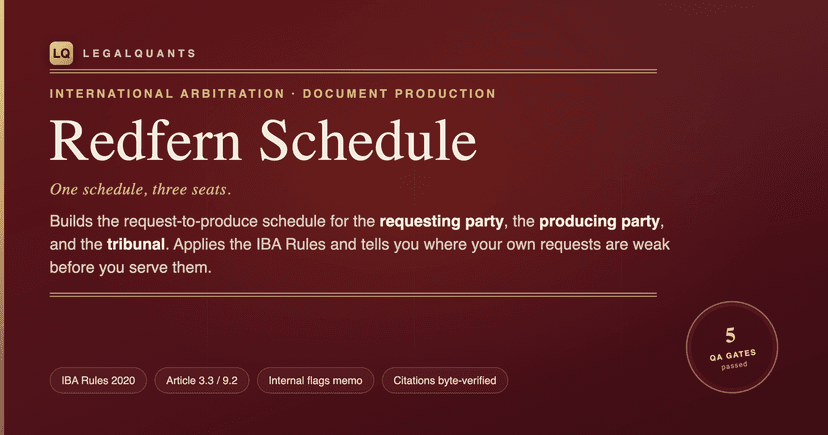
A skill for the document-production phase of international arbitration within LegalQuant's LQAI. It builds and maintains the Redfern Schedule, the request-to-produce table at the heart of disclosure in arbitration, working from one shared artefact for all three roles: the requesting party drafting requests, the producing party stating objections, and the tribunal preparing to rule. It runs each request through the IBA Rules on the Taking of Evidence (2020) Article 3.3 admissibility checklist, maps objections to the Article 9.2 grounds, and raises a content-based political-sensitivity prompt for State and state-owned parties. Every citation is verified against its official source, and it produces a private flags memo telling you where your own requests or objections are weak before you serve them. It enforces form. The legal calls stay with you.
Alexios vdSKAssociate General Counsel
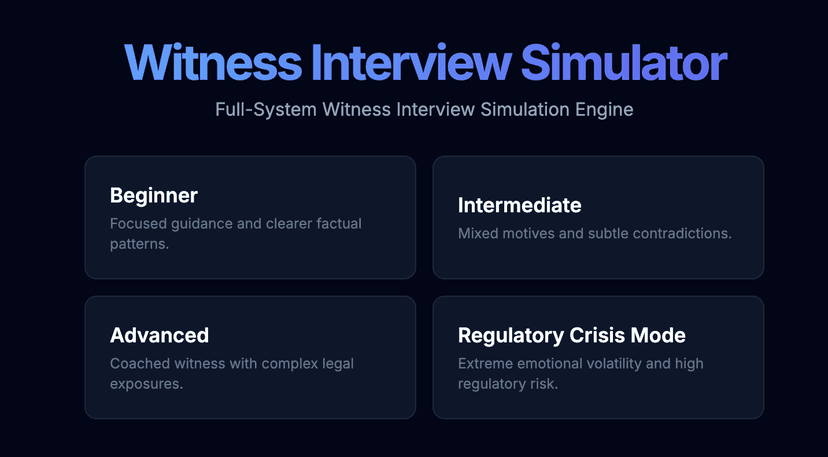
Witness Interivew Simulator is a full-system investigative interview simulator that allows lawyers and compliance professionals to practice conducting realistic regulatory interviews. It models witness behavior, interview structure, evidentiary confrontation, and downstream risk escalation to train investigative judgment in a safe, repeatable environment.
Veronica LopezInvestigations Attorney building with AI
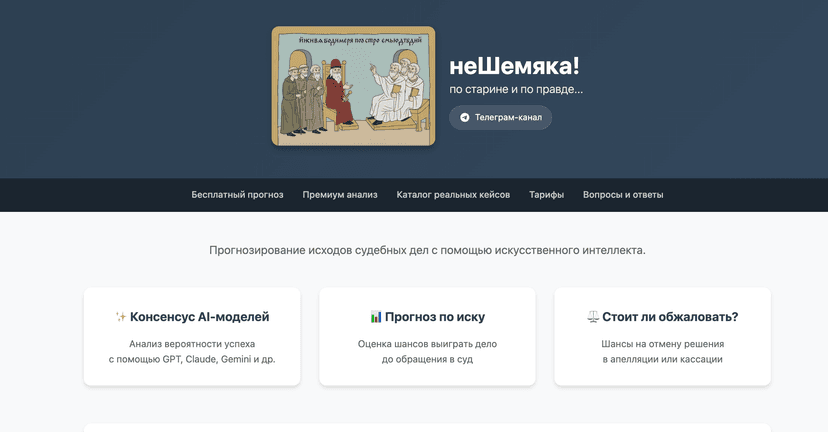
A production B2C AI service [https://neshemyaka.ru] that predicts litigation and appellate risk for individual users and small businesses. It ingests raw case text, classifies case types, and returns a 0–100 risk score with a confidence score, along with structured risk factors and practical recommendations. Built on a Go backend with PostgreSQL and a multi-model LLM layer with fallbacks, the system is optimized for low COGS, robust JSON error handling, and fast UX (magic-link auth, HTMX frontend), making advanced legal risk analytics accessible without any enterprise integration.
Nikita PolyakovLegalTech Architect (ex-Litigator)
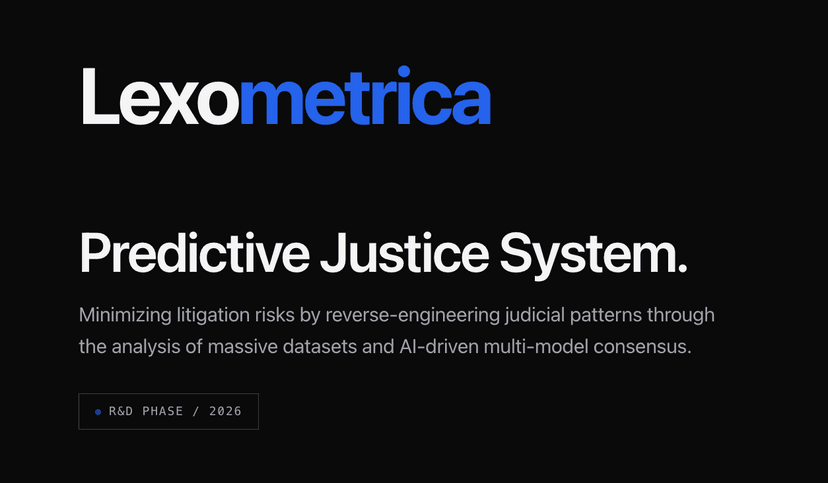
An experimental B2B predictive justice system currently in the R&D phase. Designed to eliminate uncertainty in commercial arbitration, Lexometrica functions as high-load legal infrastructure. The core architecture (Go/Python/PostgreSQL) utilizes a multi-LLM consensus pipeline to parse complex judicial patterns, evaluate litigation risk at scale, and build dynamic AI profiles of individual judges based on their past decisions and behavioral tendencies. The goal is to shift legal strategy from subjective human intuition to a statistically calibrated, API-first risk assessment model.
Nikita PolyakovLegalTech Architect (ex-Litigator)
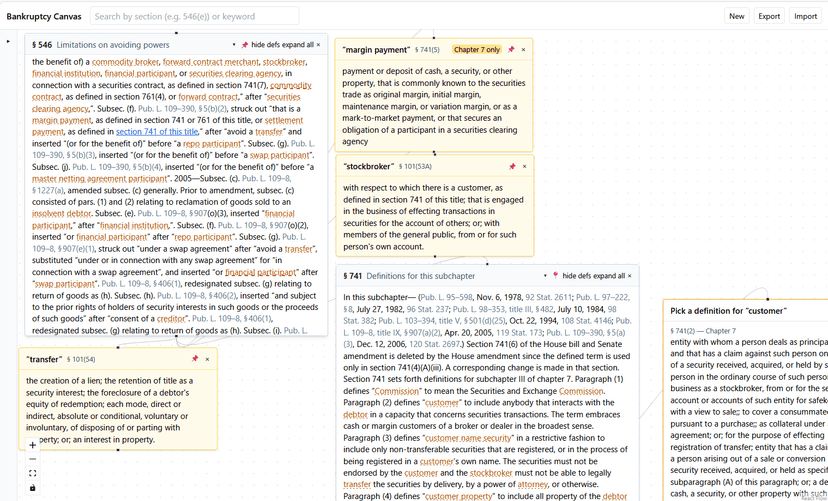
A spatial research tool for Title 11 of the U.S. Code. Pull sections, defined terms, and cross-references onto a canvas; arrange them, follow the trail, save your work.
Rebecca FordonAssistant Director of Innovation, Research & Instruction
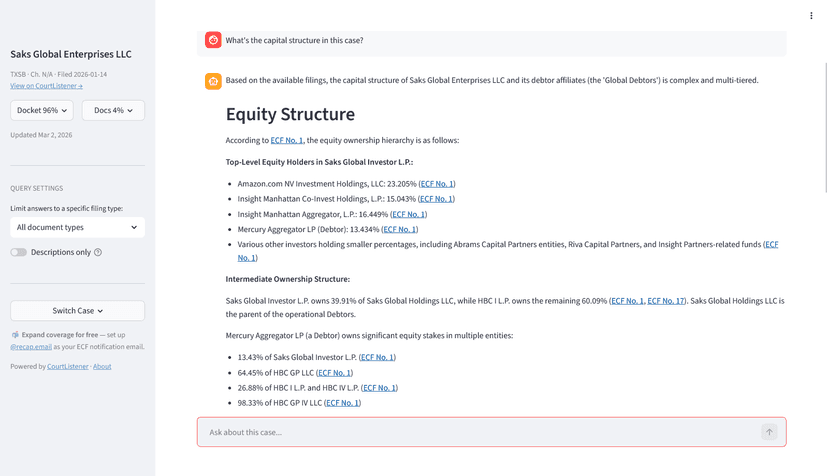
Ask natural language questions about any federal bankruptcy case — powered by documents freely available through the RECAP Archive and CourtListener API. Try the demo, install to add your own cases.
Rebecca FordonAssistant Director of Innovation, Research & Instruction
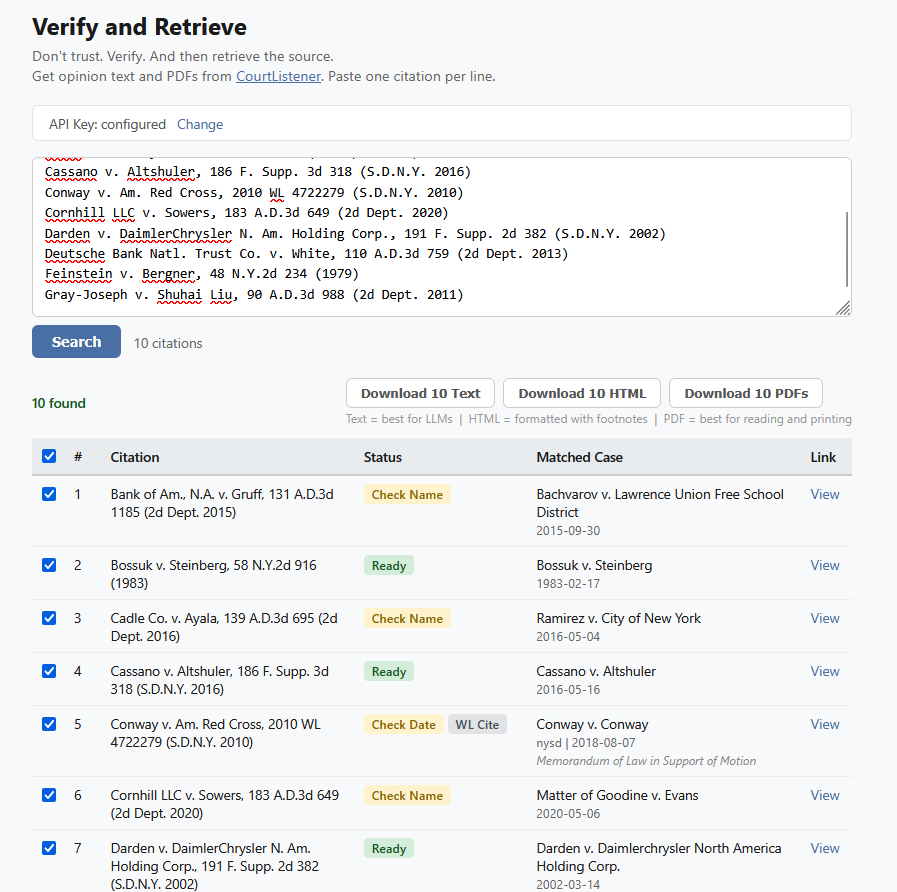
Verify legal citations against CourtListener. Catches hallucinated case citations from AI tools by checking whether a citation actually exists and belongs to the case it claims to.
Rebecca FordonAssistant Director of Innovation, Research & Instruction
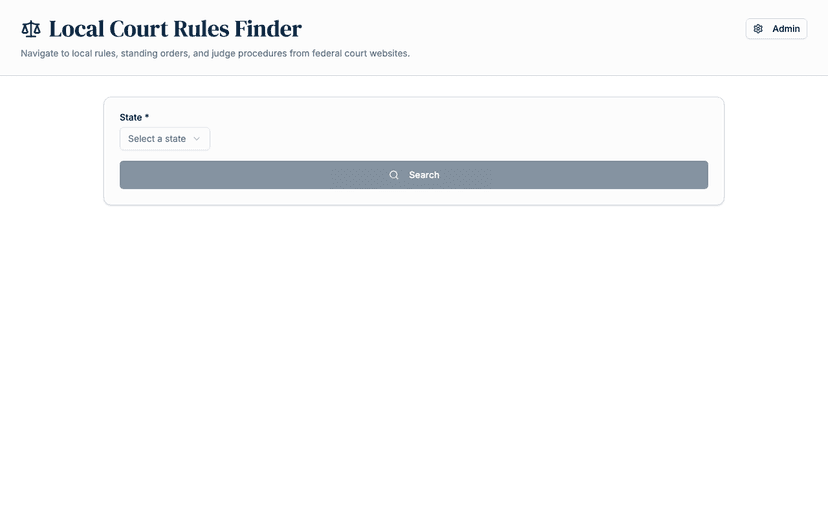
Dashboard for tracking federal and state court local rules, standing orders, and judge-specific procedures. Features an AI-powered research agent for discovering court resources and automated URL tracking.
Alyssa SonesKnowledge & Innovation AttorneyChurci audits citations in your briefs and memos. But that is not the whole story. So what is Churci? - Paste your doc or upload a PDF/DOCX and it extracts every citation automatically. - It significantly lowers your AI cost by verifying through CourtListener first and only using AI when needed. - Verifies case law against CourtListener with deduping. - Flags outcomes clearly: Verified, Ambiguous, Needs Review, Hallucinated, or Misrepresented. - Shows legal context around each cite: the paragraph and the proposition being supported. - If a citation is fake/uncertain/mis-cited, it suggests plausible real replacements structured by binding authority, persuasive authority, and secondary sources grounded so you’re not swapping one hallucination for another. And given the power of Gemini 3, you can check your citations and get suggested real cases for a couple cents. All you need is your own Gemini API key and CourtListener API key which are both linked right in the configuration screen.
M. Onur KafkasGovernment Lawyer
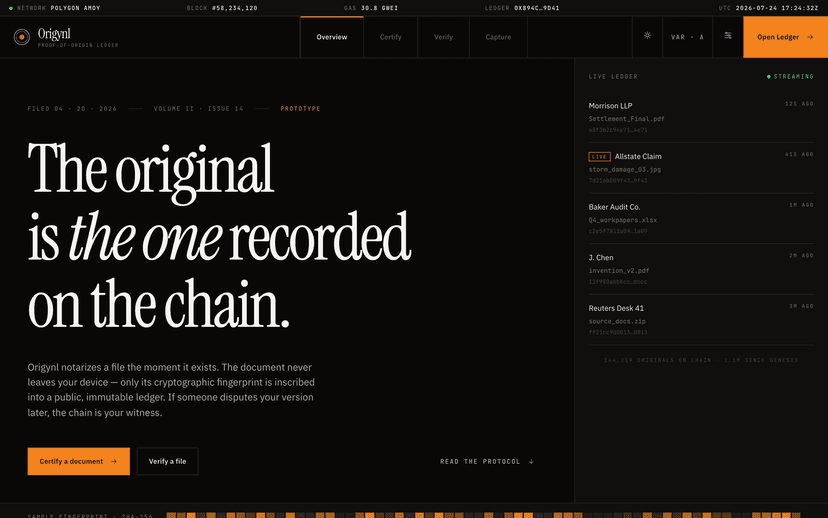
Origynl is an early-stage prototype exploring document authenticity for the AI era. It combines multi-factor AI detection with blockchain certification to prove that a file — contract, photo, record — existed at a specific moment in time, isn’t AI-generated, and hasn’t been altered since. Still rough around the edges, but the core idea is simple: a tamper-proof notary for a world where anyone can fake anything.
Zachary BrennerFounder & JD/MBA CandidateMobile-friendly version of the Hong Kong Court Diary, updated daily with verifiable sources; allows filtering by judge and easy sharing with clients.
Rocky LiBuilder
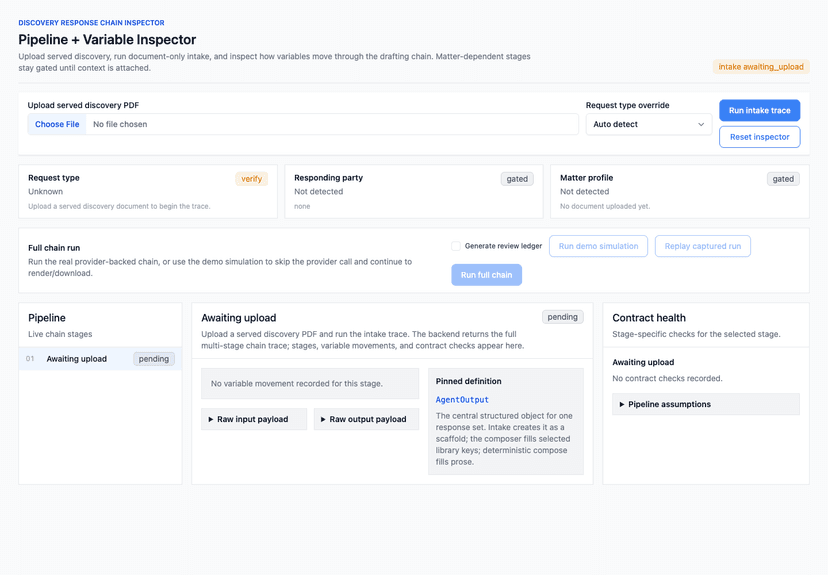
A "selection, not generation" demo for drafting California discovery-response objections — with a chain inspector that shows every move.
Sean GalvinLitigation Defense Attorney & Legal Engineer
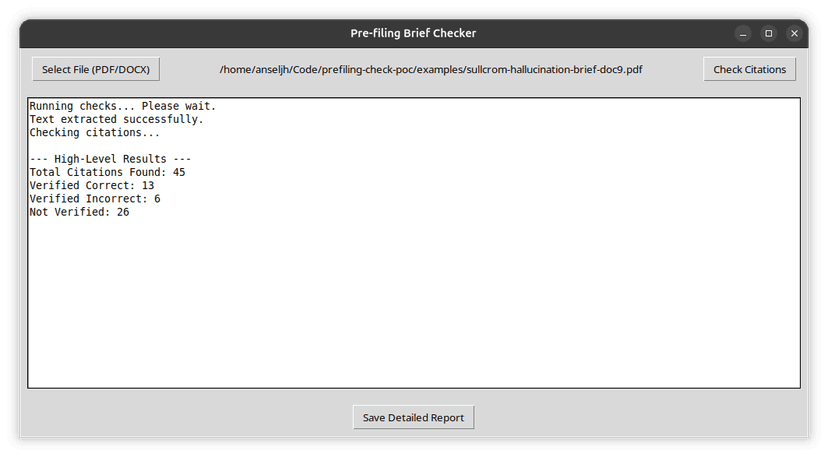
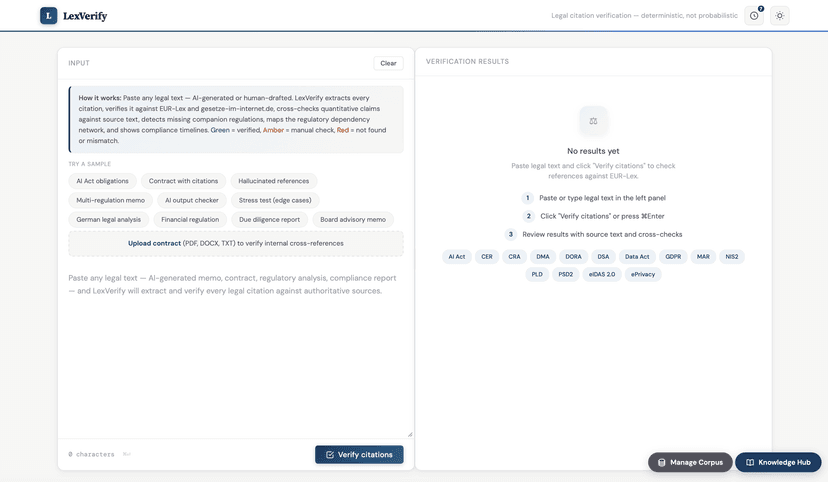
Proof-of-concept for deterministic, automated citation verification (does not use LLMs). The idea is to use something like this as an automated check before filing anything with a court, or to implement it *in* courts to alert court staff or judges to possible citation issues.
Ansel HalliburtonSenior Lead Counsel, Global Trademark PortfolioSingapore court citation checker -- detect hallucinated cases in AI-generated legal submissions. Verifies citations against eLitigation (Singapore's case law database), detecting hallucinated authorities, mismatched case names, fabricated paragraph references, and distorted quotations.
Yu Chou TeoGovernment Lawyer
Legal verification tool to combat AI hallucinations.
Patrick MunroSenior Legal Counsel | Of Counsel
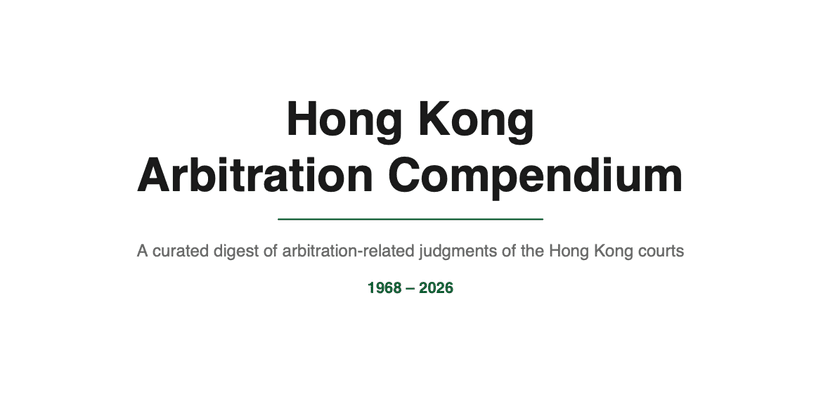
An open-access compendium containing over 1,000 arbitration-related judgments rendered by Hong Kong courts, built with Claude Code and Gemini 3.5
Troy Zhaoyi SongDisputes & Tech LawyerA multi-stage pipeline that screens major stock price drops nightly, runs plaintiff-style event-study damages estimates, then uses frontier LLMs to assess loss causation, falsity of prior disclosures, and insider-trading scienter signals. Automates the full case-evaluation workflow that securities fraud plaintiff firms currently do manually with economists and senior associates.
John HughesSpecial Counsel, Litigation
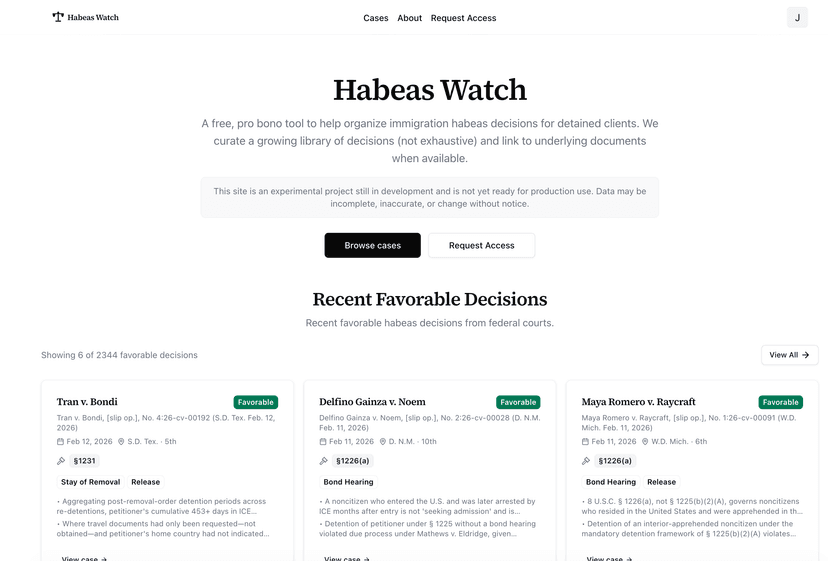
A pro bono platform for immigration habeas attorneys. Helps lawyers draft and file emergency habeas petitions fast enough to preserve venue in the district where their client was initially detained.
John HughesSpecial Counsel, Litigation
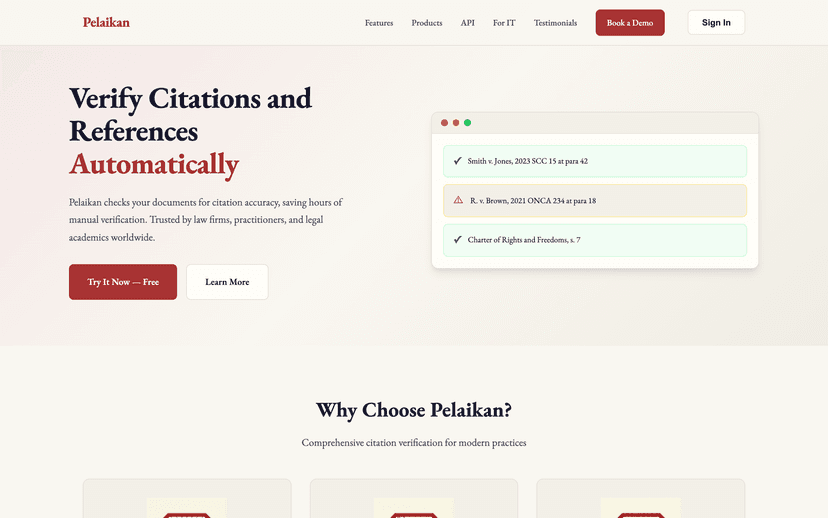
This is an automated cite checker
Damien CharlotinPlumitif
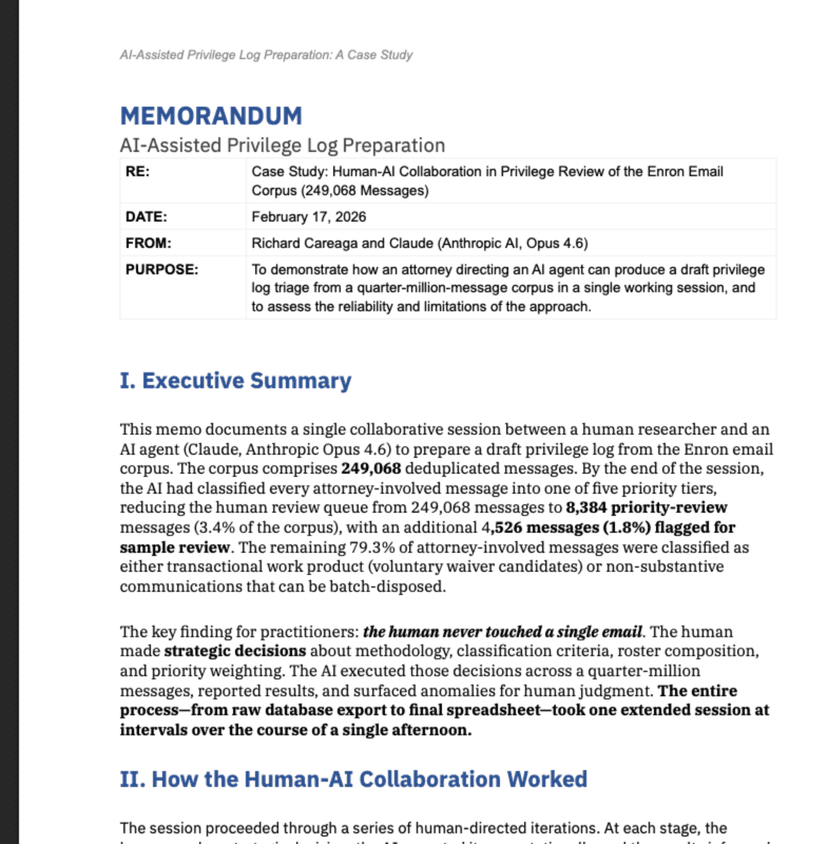
The Enron corpus of 500,000 plaintext emails from 142 document custodians is a natural candidate for LLM assisted litigation preparation. Recent changes to the U.S. Federal Rules of Civil Procedure accelerate the meet and confer to a much earlier point. Over the course of an afternoon, Claude Opus 4.6 was guided through a preprocessed, deduplicated version of the corpus. Careaga, R. (2026). Preprocessed Enron corpus [Data set]. Zenodo. https://doi.org/10.5281/zenodo.18857652 The LLM extended. my previous network/semantic analysis to identify and classify communities of email users and identify tiers most likely to contain attorney-client communication or work product privileged records and the large residuum where sampling could serve. I am currently extending that work with DiscoveryGraph.jl to implement human review where attorney judgment is required. I'm finding that the algorithms so far appear overinclusive, bringing in administrivia such as "not able to attend weekly litigation update meeting."
Richard CareagaAnalytic PragmaticianCollate is a browser-based tool for litigation lawyers that turns messy multi-reviewer feedback into a single view. Lawyers drop in several marked-up Word documents from counsel, partners, clients, and juniors; Collate parses comments, track changes, and inline edits, merging them into a paragraph-by-paragraph checklist with resolution status. Manual feedback from calls, emails, or meetings can be added and treated like extracted comments. It’s built to be a checklist and review aid, not an auto-merge tool — the lawyer stays in control and makes the edits in Word. Everything runs in the browser. A Rust engine compiled to WebAssembly parses DOCX files locally, and a React UI presents the collated feedback. A strict Content Security Policy blocks outbound network requests, so privileged documents never leave the machine and nothing is uploaded to any server. The tool works offline, and IT or compliance can verify this from the source code and CSP headers. Collate was built in about 90 minutes by a practising UK litigator using AI-assisted development. It supports inline diff display, wholesale paragraph insertions and deletions, multi-document merging via approximate paragraph matching, bulk resolution actions, search, and HTML/JSON export. The codebase is open source and includes over 100 automated tests across the Rust core and React frontend.
James Cockburnlawyer
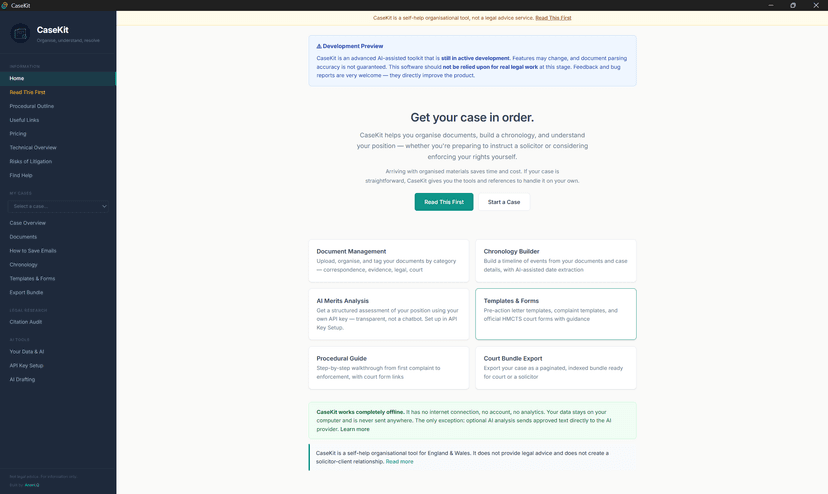
CaseKit is a free, open-source desktop application that helps you organise a consumer dispute from first complaint to court hearing — entirely on your own computer. Upload your documents, and CaseKit sorts them into evidence folders, extracts key dates into a chronology, and walks you through the procedural steps of bringing or defending a small claim. Nothing leaves your machine: no cloud accounts, no subscriptions, no data harvesting. Your case files stay in a plain folder on your hard drive that you control — you can open them, move them, or delete them at any time without asking anyone's permission. If you choose to use the optional AI features for drafting or merits analysis, you bring your own API key and the requests go directly from your device to the provider — CaseKit never sees your key or your data. CaseKit does not provide legal advice, all decisions are your own. Casekit just helps you to organise, as well as to be realistic and informed. Whether you're representing yourself or preparing to instruct a solicitor, CaseKit saves you the most expensive thing in litigation: time. Self-representing litigants can use the procedural roadmap, letter templates, and court form links to navigate the process without paying for guidance on steps they can handle alone. If you're planning to instruct a solicitor, arriving at your first meeting with an organised bundle — documents categorised, chronology built, key issues identified — means you spend that meeting on strategy rather than on your lawyer reading through a carrier bag of unsorted paperwork at £300 an hour. Either way, the AI merits assessment gives you a frank, objective, structured view of the strengths and weaknesses of your position before you commit to a course of action. CaseKit also includes something no other consumer legal tool offers: a Citation Auditor that verifies whether legal citations actually exist. Paste any AI-generated legal text, an opponent's skeleton argument, or your own draft, and CaseKit extracts every case law citation, then checks each one against BAILII and the National Archives — the two public legal databases that hold virtually every reported judgment in England and Wales. It tells you instantly whether each cited case is real, whether the name matches, and flags anything suspicious. Don't be that litigant. CaseKit is still under development, do not rely on this tool yet.

James CockburnlawyerA Word-integrated desktop tool that allows users to manage, cite and export exhibits with minimal fuss. Inserted citations can be refreshed with one click even after amendments have been made (e.g. re-ordering of exhibit numbers, re-naming of existing exhibits etc). ExhiBytes also allows users to preview exhibits without opening, annotate exhibits with internal notes, and export bundles based on selected (or all) exhibits. File formats supported are generous: PDF, DOCX, DOC, XLSX, XLS, PPTX, PPT, ODT, ODS, ODP, RTF, TXT, PNG, JPG, JPEG, and EML. ExhiBytes runs locally on the user's desktop and does not require any API key calls.
Sze Yao TanState Counsel
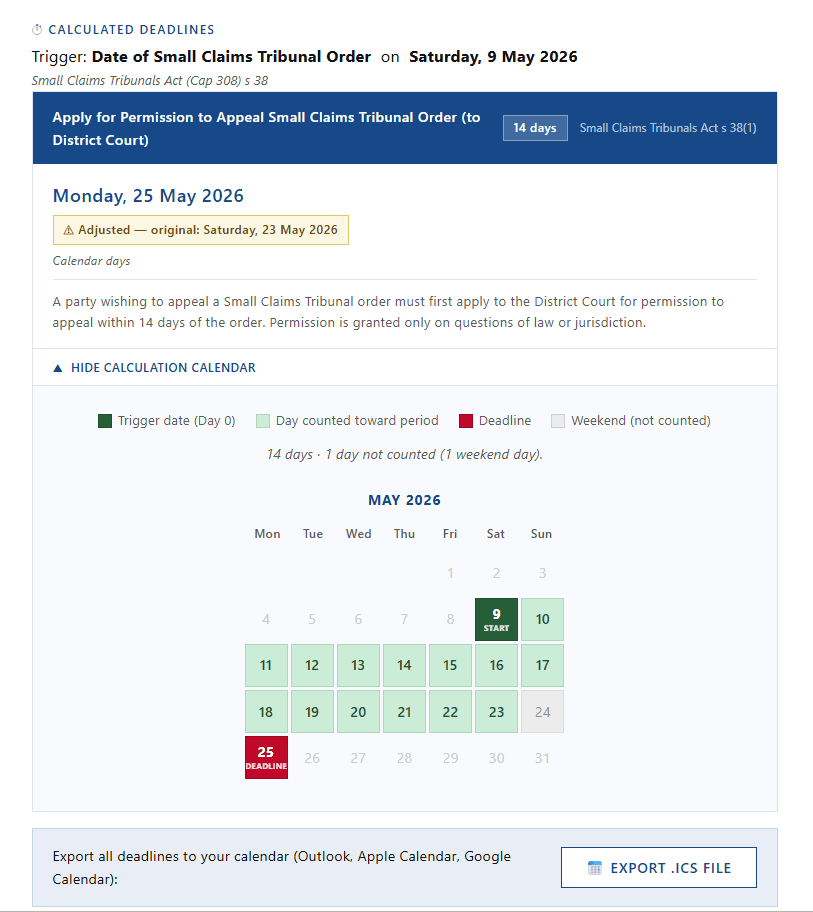
A nifty web-based tool that allows for the calculation of court deadlines (for filings etc) based on various trigger events set out in the Singapore Rules of Court 2021. Results display with a calendar view, allowing the user to re-confirm the number of days counted and the actual deadline day.
Sze Yao TanState Counsel© 2026 LegalQuants · legalquants.com · the original home of legal quants.